Don’t miss out on upcoming blog posts, free webinars, sales, and more!
SHARE
SHARE
SHARE
EMAIL
PRINT
Learn how to identify and address the main sources of workplace conflict among your employees to create a more harmonious and productive team environment.
Workplace tension doesn’t usually show up as a dramatic blowout. It’s the result of messages that never got through, responsibilities that overlap in ways nobody clarified and small frustrations that pile up week after week. The numbers tell an interesting story – around 70% of workplace conflicts start because communication between team members broke down somewhere along the way. What piles onto this problem is that most managers were never trained on how to handle conflict at all. The cost of all this drama extends beyond those awkward break-room moments. On average, businesses wind up spending $3,216.63 per employee every year just to resolve disputes.
Every company deals with the same basic conflict triggers, no matter the industry they’re in or how big they are. It’ll drain your productivity fast and make even your best employees start to browse job boards. Teams fight over the budget all of the time because there’s never quite enough money to go around, and your top performers get frustrated when they watch their coworkers do the bare minimum for the same paycheck. You have four different generations working together, and each of them has its own ideas about how work should be done and how everyone should communicate.
You’re well on your way to a much healthier environment for everyone on your entire team. Conflict is always going to happen when teams work together on something – that’s unavoidable. What counts is your ability to find the actual cause early enough that you can fix it and stop it before it snowballs into a toxic situation that ends up hurting your whole department.
Let’s dig into the most common workplace tensions so you can address them proactively!
Recommended event from HRDQ-U
Want to learn more? Watch a webinar or join a workshop on this topic.
Managing Conflict in the Workplace
Join us for Managing Conflict in the Workplace, where you’ll learn how to achieve the benefits of constructive conflict management. Led by David Alumbaugh, we’ll explore the three most typical types of conflict and the five strategies for managing it.
When information doesn’t get to where it needs to go, problems can start to pile up pretty fast. A manager might make a pretty simple decision during a morning meeting. If nobody passes that information along to the afternoon crew or to the team members who work remotely, everyone ends up with different goals without even realizing it.
Project needs change all of the time, and that’s just how modern work environments work. The problem starts when those changes get made, and only some of the team members actually hear about them. One department will move ahead with the updated plan as another group still works on what they think is the right version. Neither side has done anything wrong here. But now their work doesn’t line up, and everyone ends up frustrated with one another.
Email and messaging apps were supposed to make communication easier, and in a lot of ways, they have. But these tools also remove a lot of the context that you’d normally get during a face-to-face conversation. Written messages create misunderstandings all the time, and it’s a problem that still happens, no matter how careful everyone tries to be. A person writes out a reminder that seems perfectly simple to them, and the recipient reads it with a different tone in mind or misses out on an important detail that would’ve made everything click.
Verbal agreements can be a headache for everyone. When two team members have a conversation, they both usually walk away from it feeling like they’re on the same page about whatever it was they just talked about. When there’s nothing written down to refer back to, though, memories start to fade and drift as time goes on. What one person remembers as a firm commitment might sound a lot more like just a casual suggestion to the other person. Eventually, a full disagreement breaks out about what it was that was actually agreed upon, and neither side has any concrete proof to back up their version of events.
Remote workers face these challenges every day. They don’t get those hallway conversations where they can just ask a quick question and get an answer right on the spot. They don’t get those little clarifications that happen when everyone’s in the same office. When information finally makes it to them, it’s usually been passed through a few different team members already, or it’s been condensed down into a short message that doesn’t include all of the context that they actually need.
When Job Boundaries Get Too Fuzzy
Role uncertainty can build up on a team without anyone realizing it until it’s already a big problem. When your entire team doesn’t have a solid sense of where their responsibilities end and their coworkers’ responsibilities start, you’re going to see lots of dysfunction start to build up. Sometimes two teammates will duplicate the exact same work without realizing it, and they end up creating conflict in the process. Other times, important tasks get missed when everyone on the team assumes that somebody else has already taken care of it.
Company changes typically make this problem even worse, and it happens fast. Reorganizations blur the boundaries between different roles and what each one is supposed to do. Mergers are especially messy because you’re combining teams from two separate companies, and lots of times those team members have overlapping responsibilities with no definite plan for who’s going to take care of what after everything settles. Nobody can pin down who owns which tasks during these periods, and all that ambiguity just creates more uncertainty.
Different departments run into this issue at different rates, and some of them definitely have it worse than others. Marketing and sales teams are especially notorious for it – they tend to disagree about who should actually handle customer relationships at each stage of the process. IT departments face their own flavor of the same problem when different teams across the company figure they’d rather just take care of their own technology needs instead of going through the standard processes that IT put in place. Customer service and account management teams also have plenty of overlap between them, and it creates tension on both sides because nobody’s sure where one role ends and the other one begins.
Lots of businesses try to fix this problem with something called a RACI matrix. This framework outlines who is Responsible for doing the work, who is Accountable for the outcome, who needs to be Consulted along the way and who should be kept Informed. It helps get all these boundaries documented so nobody on your entire team has to waste time guessing about where they fit in.
Tools like this will only work if you update them on a consistent basis. When a team member gets promoted or a new project launches, all of a sudden, the old agreements don’t match with reality anymore. What made sense 6 months ago might not match how the work actually gets done now.
Job boundaries can get fuzzy and confusing pretty quickly. Most work tends to be messy and collaborative anyway. Team members will want to help out when they see gaps or spot a chance to contribute something valuable. If you don’t have some sort of agreed-upon structure around who gets to make decisions on what, those helpful intentions can turn into territorial disputes in no time. And once that happens, it damages working relationships and hurts productivity a lot.
Teams Fight for the Same Resources
Every team needs resources to get their work done, and when those resources start to run thin or feel like they’re being distributed unfairly, tension between departments and coworkers builds up fast – sometimes within a matter of days or weeks.
Budget allocations create more friction than just about anything else in most organizations, largely because every team thinks they deserve more money compared to what they currently get. One department might receive a massive budget increase for the upcoming year, while another department down the hall remains stuck with the same limited budget they’ve been working with for years on end. That disparity breeds resentment fast. When teams get passed over repeatedly for the funding they need, they’ll eventually start to believe that leadership doesn’t value their work or doesn’t actually care about what they’re trying to accomplish.
Physical workspace causes plenty of friction, too. Office spaces with windows or desks that are close to where the executives work turn into competitive territory between teams – and that makes sense because everyone wants the better location. Equipment access creates the same tension. When multiple employees need to use the same tools or technology, scheduling conflicts have a habit of escalating into personal disputes pretty fast.
Software licenses and technology subscriptions add some more complications to the mix. Lots of businesses will buy a limited number of seats for their most expensive programs, and it means employees wind up having to share access or wait for their chance to use them, which can be pretty frustrating when a deadline is approaching, and you’re stuck waiting because you can’t get access to the software you’ll need to do your work.
Remote work has created some resource battles that businesses never had to deal with in the traditional office setting. Video conferencing slots are a limited resource now, particularly during peak business hours when everyone needs to schedule their meetings. Cloud storage caps are another pain point – teams wind up cleaning out old files and documents just to free up space, or they have to submit requests to IT for a storage increase. Online resources can seem less tangible than the physical ones. But the friction they create between teams ends up being just as intense.
Transparency can help reduce these tensions between teams. When everyone can see how leadership makes allocation decisions, they’re much less likely to believe that someone’s playing favorites or treating them unfairly. Open communication about budget constraints and resource limitations helps too. If you don’t have that information, decisions that might make perfect sense to leadership can seem random or unfair to everyone else on the team.
This whole problem gets even worse when nobody can see how the allocation process actually works. Employees are going to fill in those information gaps themselves and they’ll silently make up their own stories about what’s going on. Before long, they’ll start to believe that other departments are receiving preferential treatment, or that maybe their requests are just being ignored without any real reason. This breeds a sense of unfair treatment, and it damages morale quite a bit – and creates divisions between teams and departments that need to be working together instead of against one another.
When Age and Culture Clash at Work
Different generations and cultures each bring their own expectations to the workplace. A typical team will have employees who started their career before email even existed, seated right next to employees who’ve never known a world without smartphones. When these gaps get ignored or brushed aside, friction has a way of building up, and over time, it turns into the constant conflict that nobody wants to deal with.
Communication styles vary pretty wildly from one employee to the next. Younger workers usually like quick messages and want to check in with their teams a few times each day. More experienced colleagues tend to prefer face-to-face conversations and would rather keep communication a bit more formal. A Slack message feels fast and efficient to one worker but comes across as cold or impersonal to another worker. Communication styles like these can shape how workers see urgency and respect at work.
Flexible schedules can create plenty of friction between generations. A younger employee might want to work from home a couple of days a week, or they might want to move their schedule around to fit their life outside of work. Their manager (who probably grew up in a very different work environment) might believe that dedicated employees show up at the office every day. Neither side is wrong here – they just grew up with different ideas about what a professional workplace should look like.
Cultural background makes this even more complicated. Some cultures treat direct confrontation as a sign of honesty and a way to actually solve problems. Other cultures see that exact same behavior as rude and damaging to how well the group gets along. An employee from the first type of culture might bring up a problem very directly because they believe that’s how to be constructive. These kinds of situations can turn into misunderstandings pretty fast.
Technology always brings a whole batch of problems along with it. Some employees will jump on new tools the second that they become available, and others need a bit more time before they feel comfortable with the change. The ones who adopt them quickly can get impatient with how slowly everyone else seems to move. The ones who need more time start to feel pressured, and they get defensive about the whole situation. Before long, everyone ends up frustrated with one another.
Generational and cultural differences don’t disappear on their own over time. Usually, they stay right beneath the surface and quietly shape how the members of your entire team interact day after day. What starts out as a minor miscommunication might not feel like much. But it can slowly turn into genuine resentment if nobody actually takes the time to work through it.
What You Can Do About Conflict
Workplace friction usually comes from multiple different sources, and it’s not usually just one factor causing the problems. The first step is to find the root of the tension to make conditions better for your entire team. When you can see what’s actually causing the problems among your entire team members, you can start to take action and fix it. Maybe it’s poor communication between departments that don’t talk to one another enough, or maybe it’s the stress that comes from not having enough resources to get the job done. Whatever the source is, every kind of conflict needs its own particular solution.
Conflict isn’t the enemy – that’s something I figured out pretty early on. What makes the difference is how managers respond when tension surfaces in their teams. Some would rather ignore the friction and hope that it resolves itself over time. That almost never pans out the way that they expect. Other managers take the opposite approach and rush straight into fix-it mode before they understand what’s actually driving the conflict. The managers who get the strongest results are usually the ones who pause long enough to find out the source of the problem and then give their teams some helpful ways to work through disagreements so the situation doesn’t fall apart.
Brad Glaser is President and CEO of HRDQ, a publisher of soft-skills learning solutions, and HRDQ-U, an online community for learning professionals hosting webinars, workshops, and podcasts. His 35+ years of experience in adult learning and development have fostered his passion for improving the performance of organizations, teams, and individuals.
Recommended Training from HRDQ-U
Managing Conflict in the Workplace
Join us for Managing Conflict in the Workplace, where you’ll learn how to achieve the benefits of constructive conflict management. Led by David Alumbaugh, we’ll explore the three most typical types of conflict and the five strategies for managing it.
Check out our top-selling training materials on this topic.
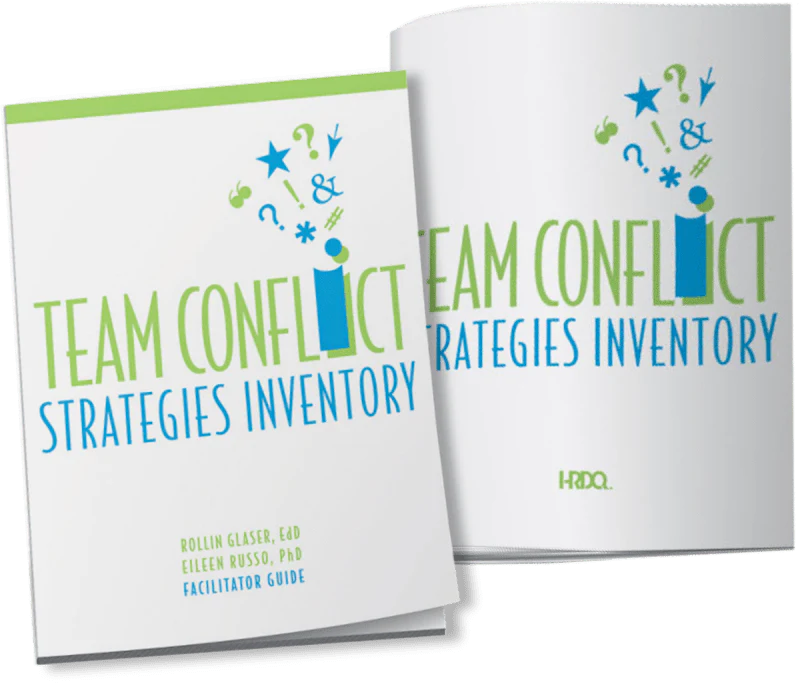
Team Conflict Strategies Inventory
Each team has its own preferred method for managing conflict, though not all methods are effective. Some teams avoid conflict at all costs, while others thrive on the energy and motivation it brings. The Team Conflict Strategies Inventory offers an excellent chance for teams to address issues and formulate effective conflict resolution strategies within the team.